
Projects / Field Report
Kite-Lifted 40 m End-Fed Activation
Taking a very predictable 40 m EFHW, hanging it under a kite, and finding out what happens once the antenna refuses to sit still.
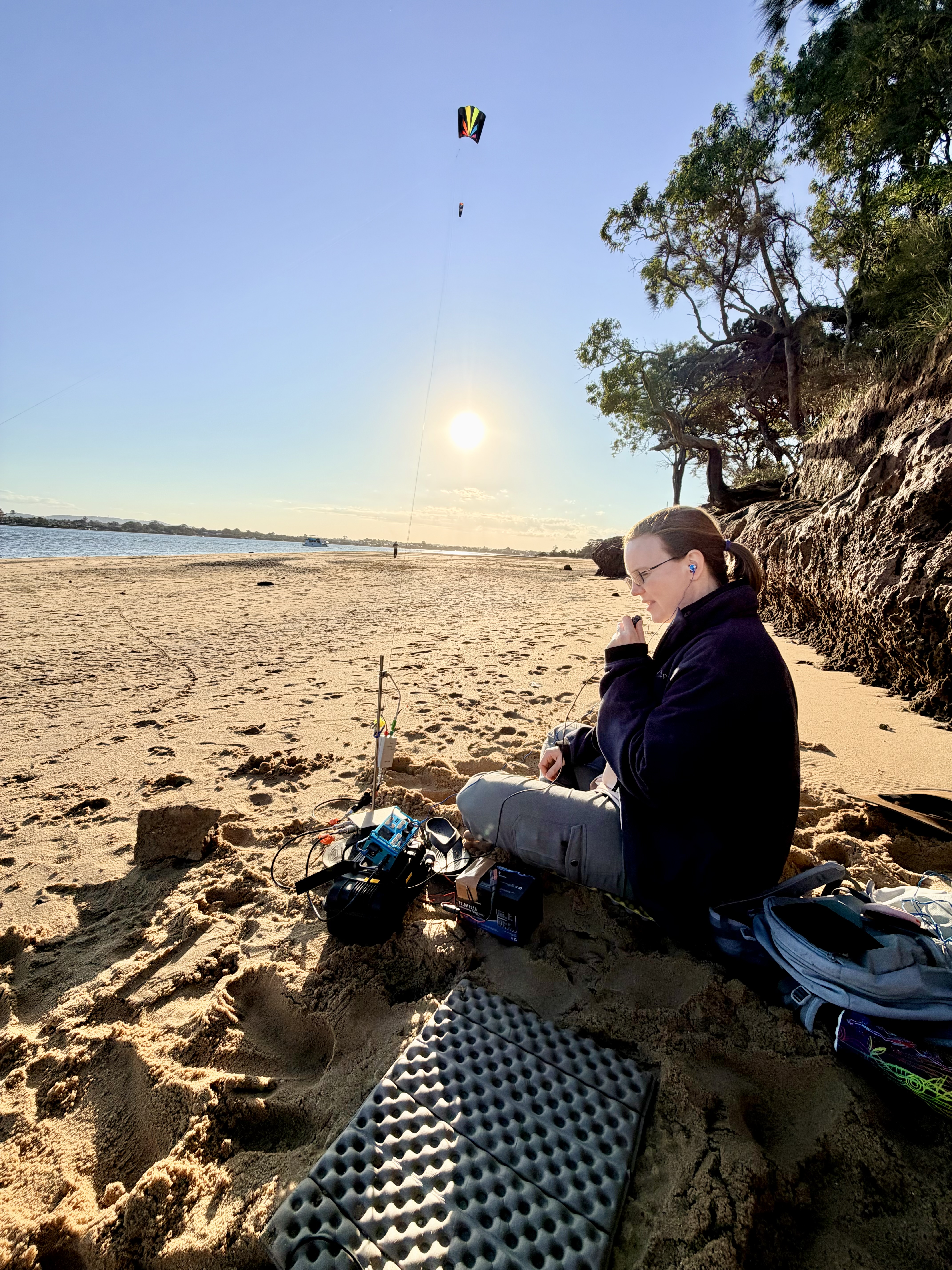
On Sunday 21 September 2025, VK4KLB and I headed out to Main State Beach on Coochiemudlo Island for a two-fer activation of AU-8924 and Moreton Bay Marine Park, AU-7027. By 0600z it was just after 4 pm local time, with a solid Queensland afternoon sea breeze and enough wind to finally justify trying an antenna idea I had been carrying around for years.
I have a 40 m EFHW that I know very well. In its normal portable configuration it is tuned around 7.074 MHz and goes up as a sloper from roughly 9 metres at the high end to about 2 metres at the feedpoint. The transformer is a 56:1 autotransformer wound on an FT82-43 with an FT50-43 nested inside, built on the UniBalun PCB from DG1JAN, and the wire is insulated SOTABeams. Put it up normally and it is very predictable, sitting comfortably below 1.5:1 SWR across the resonant bands and practically 1:1 on 15 metres.
Which made it an excellent candidate for doing something unreasonable to.
I had wanted to hang the same wire under a kite for years, partly because it looks fantastic and partly because I was genuinely curious about how much of an antenna’s nice behaviour comes from forcing it to stay in one geometry. A fixed sloper does not change much once it is up. A kite-lifted wire changes height, angle and tension every time the wind does something, so all of the things I can normally ignore become rather more visible.
Getting it into the air
We chose a position well clear of anyone walking along the beach because a long tensioned wire under wind load is not something I wanted drifting over people if the kite decided to misbehave.
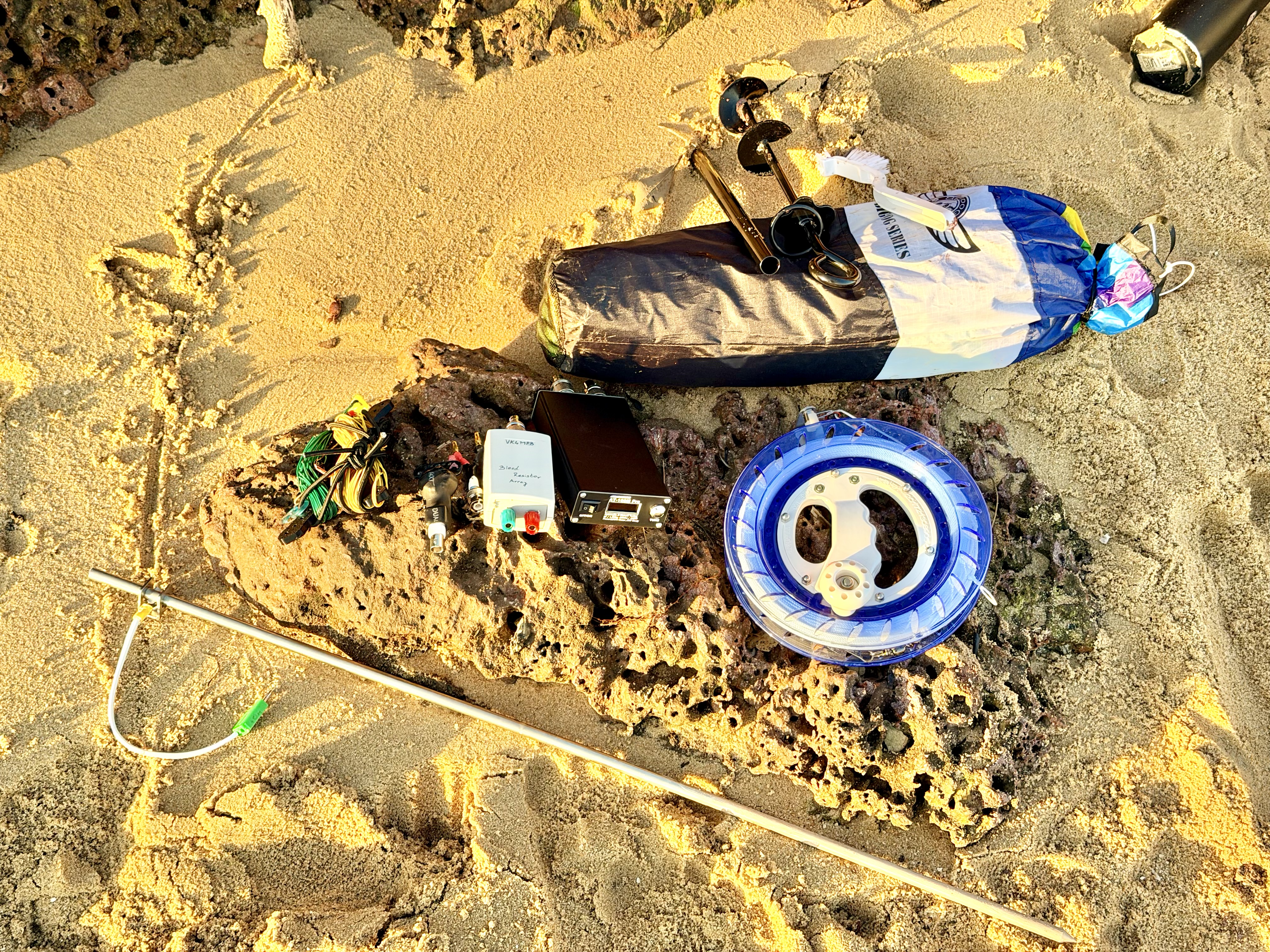
The lifter was a Rainbow LS-17.5 sled on Dyneema rated to 200 kg. Wind was under about 15 km/h, with gusts below 25 km/h, so it was steady enough to work with rather than the sort of day where the kite spends its time alternating between trying to leave Queensland and trying to bury itself in the sand.
Once it had some height, the antenna was sitting somewhere around 22 metres above the beach at the top end and sloping back toward the operating position.
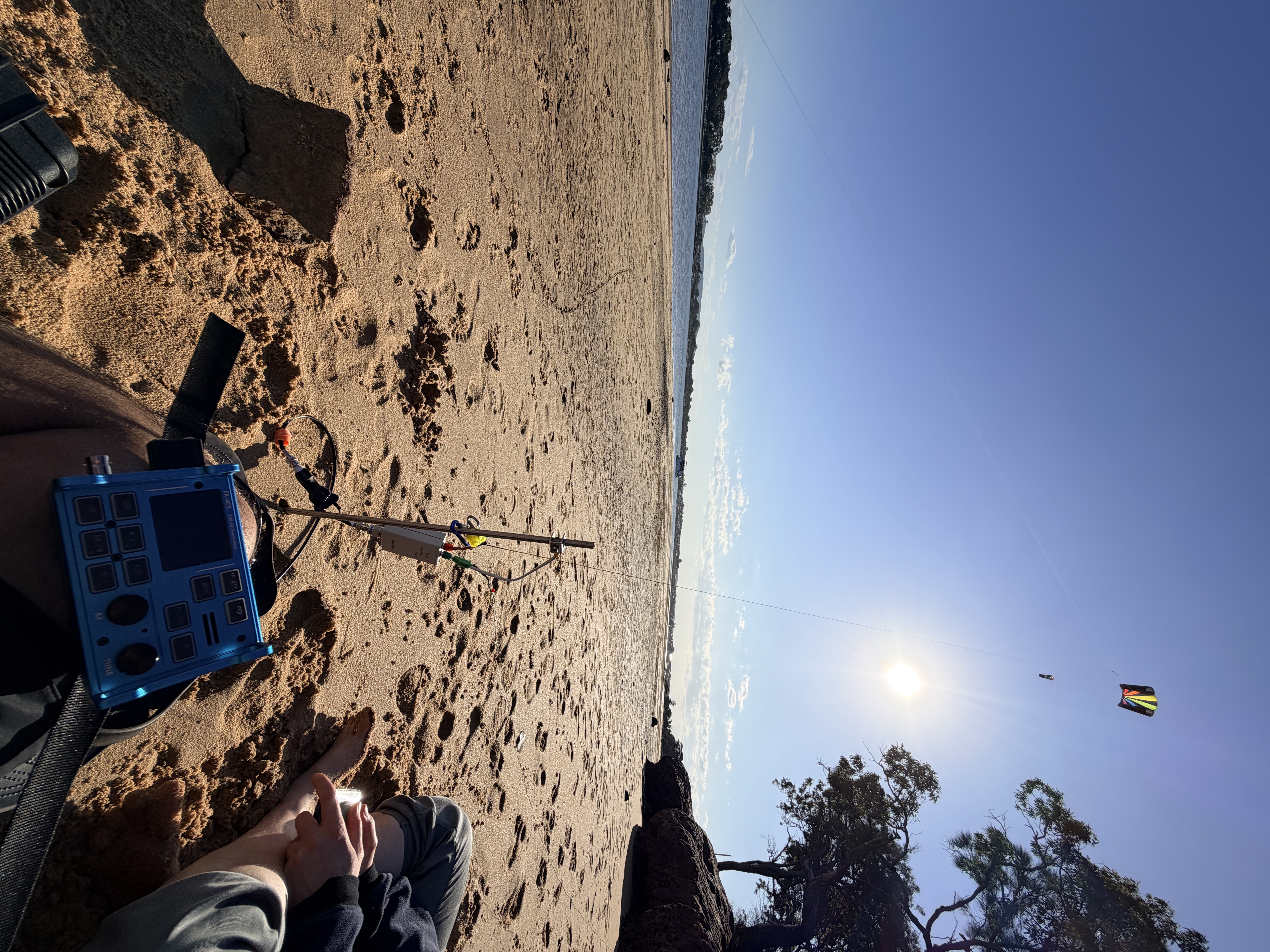
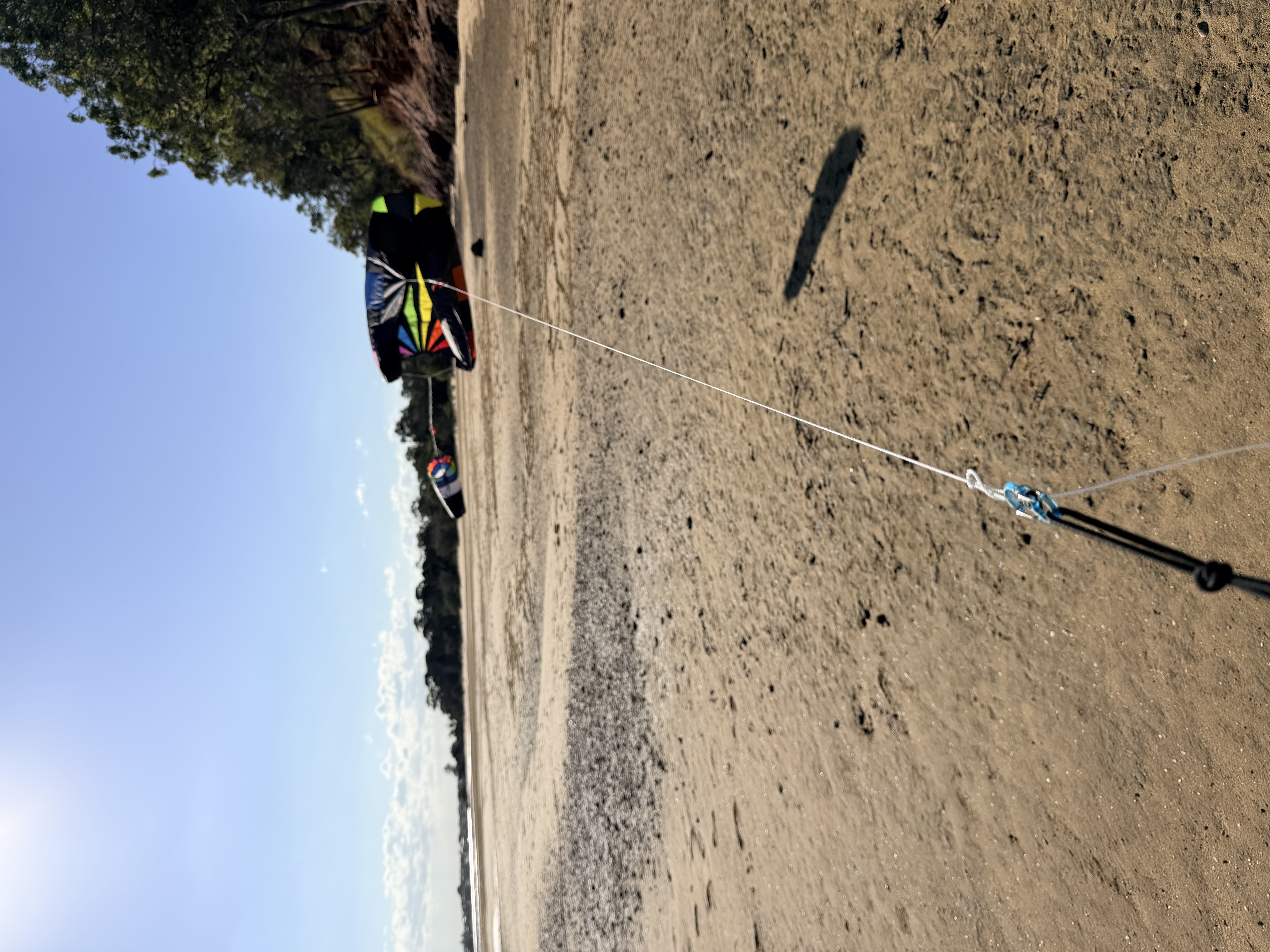
The antenna was attached into a loop in the kite line about two metres below the bridle, with a short section of bungee between the Dyneema and the antenna wire. That little bit of elasticity was deliberate. Dyneema has almost no stretch, which is excellent for a kite line but less wonderful if every gust is being transmitted directly into an antenna transformer, stud or solder joint.
So the kite line carried the mechanical load while the antenna simply followed the slope. The bungee took the edge off the gusts, and the RF hardware was left to do RF work rather than moonlighting as part of the rigging.
If I were building the same system again, I would make exactly the same decision. I would not use the transformer box or antenna terminals as part of the load path because there is no good reason to ask them to be structural components. Let the rope take the pull. Let the antenna hang from it. Give the wind something elastic to argue with.
The radial remained independent of the kite system. It was about 7.8 metres long and sat roughly 1.5 to 2 metres above ground, so the moving part of the setup was the main wire rather than the whole antenna changing shape in every possible direction at once.
The RF chain and the static problem
The RF side was mostly my usual portable setup. About 5.6 metres of RG58 CU ran from the transformer into a static bleed box, then through a ferrite choke and AT-100M Pro tuner before reaching the FX-4CR.
The bleed box contained five 1 MΩ resistors in parallel, giving an effective resistance of 200 kΩ, with a short ground strap running to a 1.3 metre steel ground rod.
Yes, the rod went into sand. That is what the beach provides.
I kept the ground strap under 30 cm because if the whole point is to give static a short path away from the radio, there is not much sense in making that path wander around first.
The bleed network also turned out to be rather less optional than it might look when drawn as a little box in the signal chain.
Static built quickly. At one point I measured more than 3 kV on the wire, which is a very effective way of confirming that the box full of resistors you bothered to build was a good use of your time.
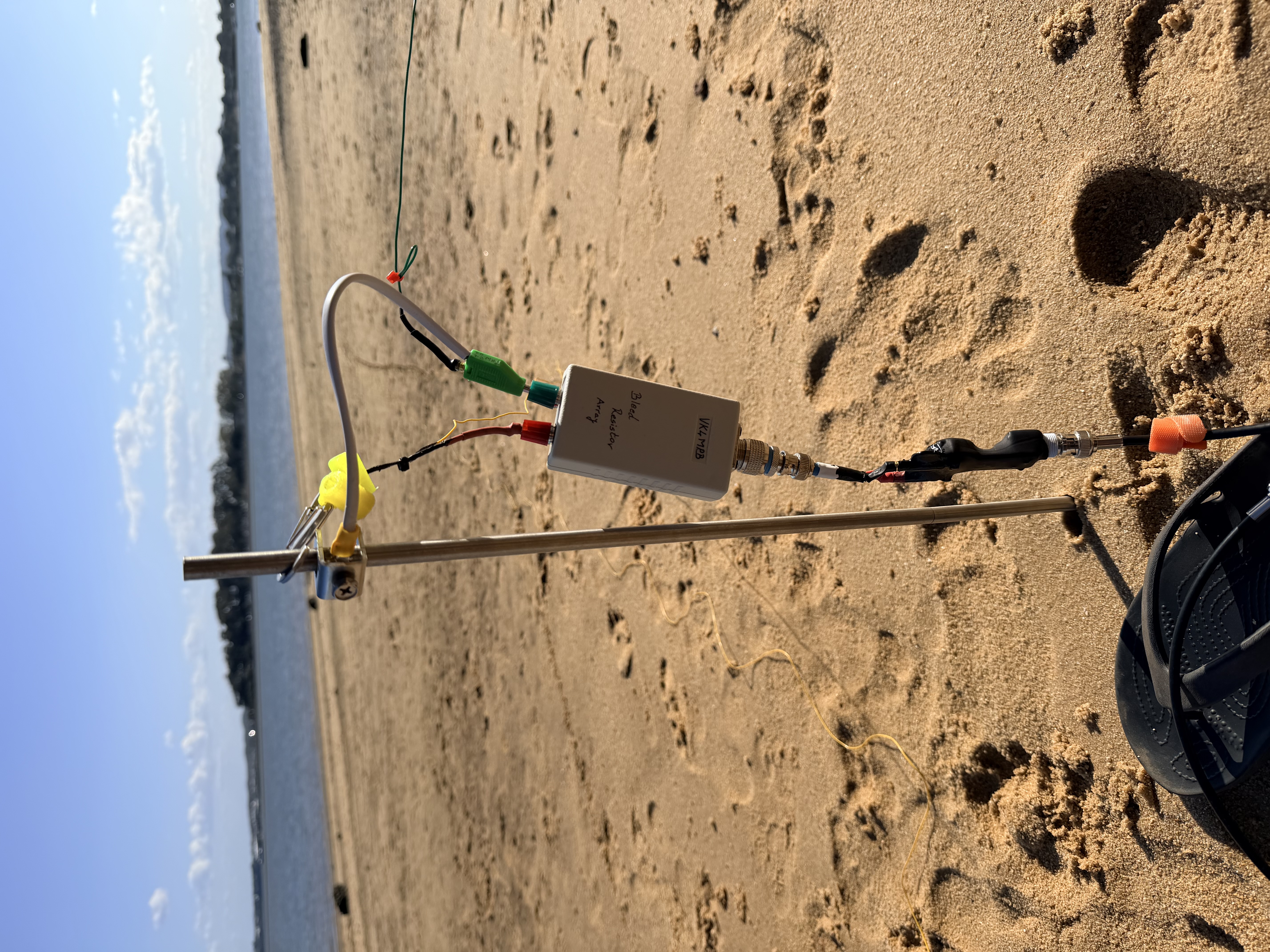
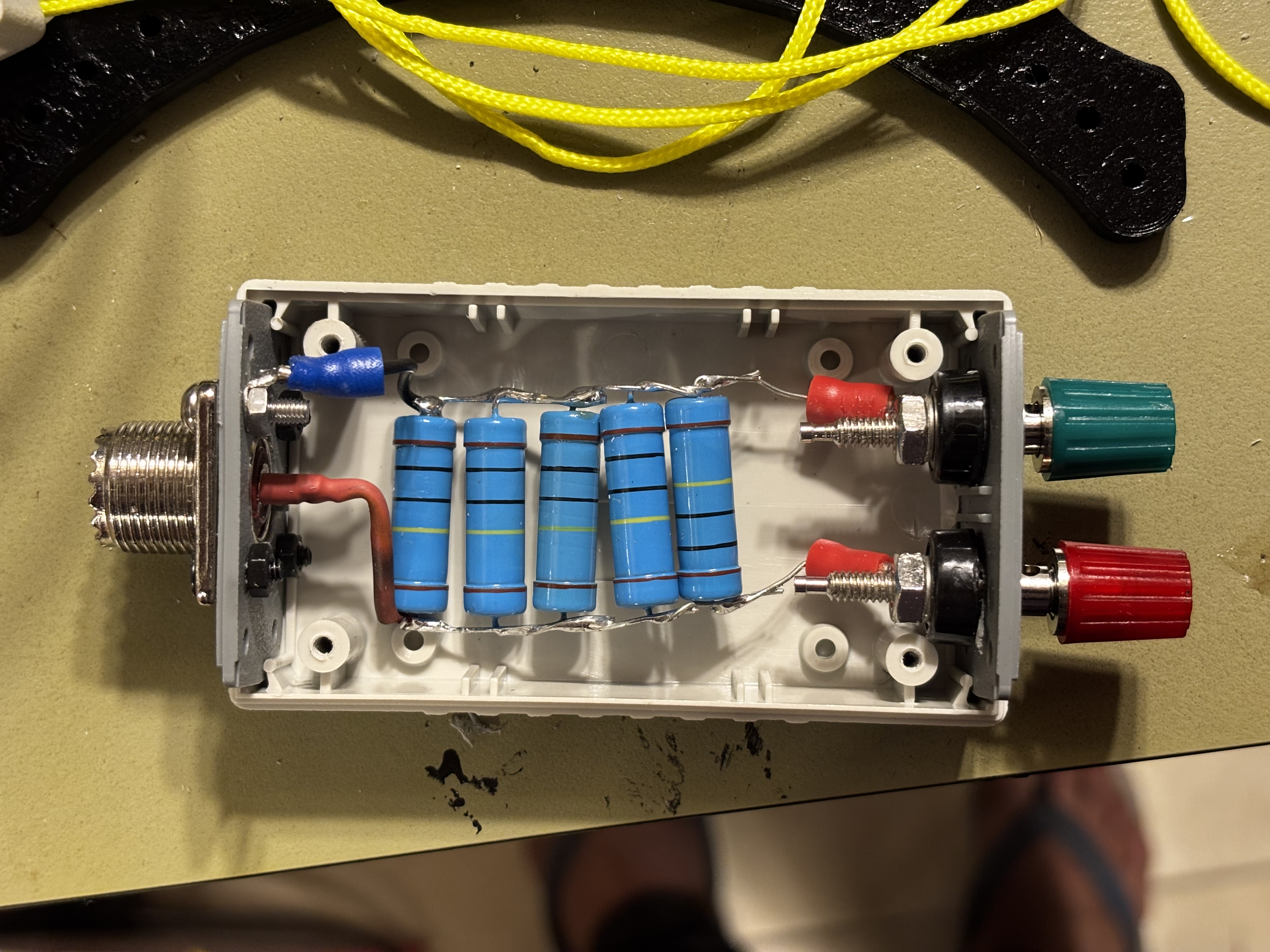
The purpose of the bleed network was not to somehow prevent the antenna from accumulating charge. A long wire moving in dry coastal air is going to do that whether I approve or not. The point was to let that charge leak away continuously instead of waiting until the radio offered a more interesting route to ground.
Nothing made it through to the radio, and after seeing the voltage on the wire I was perfectly happy for the resistor box to remain the least exciting piece of equipment on the beach.
Once we started calling
We started at 0601z, just after 4 pm local time, and the band was behaving well from the beginning. VK4DTS and VK4CYA were both in the log at 06:01:56z with 59 reports, followed a few minutes later by VK2OKR, VK2BXB and VK2AUS with reports around 55 to 56.
The antenna, meanwhile, had no intention of behaving like the nice fixed sloper I was used to.
As the wind changed, the angle moved constantly between roughly 60° and 25°, and the SWR moved with it. There was no one resonant point to find and admire because the geometry rarely stayed the same long enough to deserve one.
The AT-100M Pro spent the activation following those changes. A gust would lift the kite, the wire angle and height would change, and the tuner would respond. When the kite dipped again, the numbers moved back. It was not unstable in the sense of being unusable; it was simply a system whose geometry was continuously changing.
That distinction matters because I do not think a moving antenna needs to be treated as a failed antenna. It does mean that the normal expectation of tuning something once and then forgetting about it no longer applies. With this setup, the tuner was doing useful work throughout the activation rather than simply cleaning up one fixed mismatch at the start.
At 06:13:29z, F5PYI came back from France, 59 both ways on 40 metres. Standing on a beach in Moreton Bay, looking at a wire wandering around under a kite while working into Europe, I was quite happy with that.
The contact did not prove some sweeping new point about antenna theory. It did establish that the continually changing geometry was not preventing the system from doing its actual job.
Field instrument / two-fer log
Activation log
Unique contacts from both park records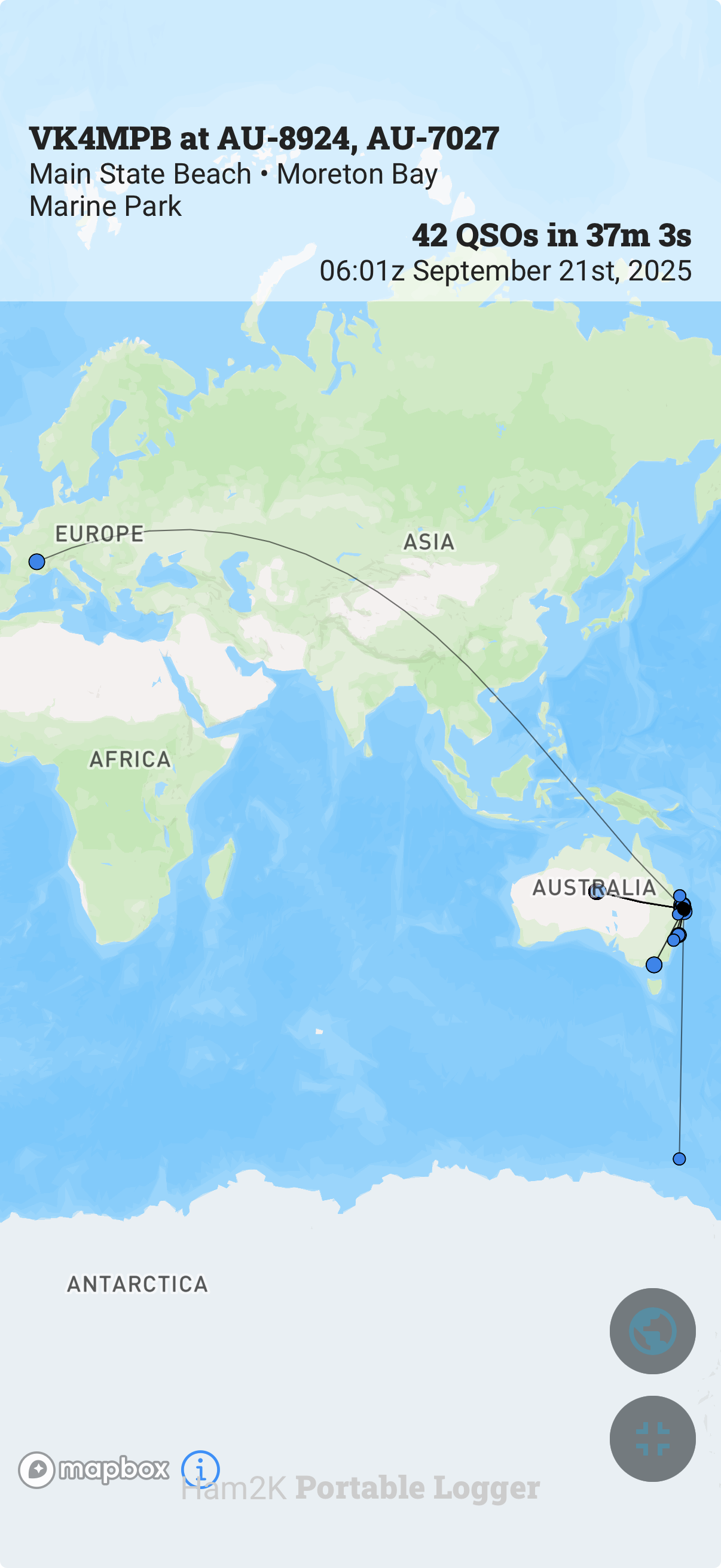
Band breakdown
| Band | QSOs | Share |
|---|
Contact rate
Inspect the complete QSO log
| UTC | Call | Band | Mode | RST S | RST R | Grid | References |
|---|
The kite comes down
The system continued working until VK3PF at 06:36:11z, also 59 both ways, when the kite stopped participating in the experiment.
It did not descend gracefully. It lost lift and came back to the sand during the QSO.
Mechanically, though, the system behaved the way I had hoped. The Dyneema and anchor took the load, the bungee isolated the antenna, and nothing tore itself out of the transformer. The heavy-duty dog stake holding the kite line had been vibrating under the sustained pull, but when the kite dropped the whole system simply relaxed rather than transferring a final shock into the RF hardware.
Almost immediately, a dog on the beach decided that the bright collapsed sled kite was clearly the most interesting thing that had happened all afternoon and ran toward it at speed.
We retrieved the kite before it acquired a new owner, reset everything and put it back into the air.
By the final QSO at 06:39:00z, we had logged 42 contacts across AU-8924 and AU-7027 in just over 37 minutes. The antenna angle had spent the entire activation moving around, the SWR had followed it, the kite had come down once and the static had exceeded 3 kV, but the system kept making contacts.
Looking back at it later, what interested me most was not any one component. The whole thing worked because the mechanical and RF parts had been treated as one system. The Dyneema carried the load, the bungee absorbed gusts, the tuner followed the changing geometry, the choke kept RF out of the operating position and the bleed network gave static somewhere less expensive to go.
Remove one of those assumptions and it becomes a different experiment.
That was probably the main thing I took from the activation. A kite-lifted antenna is not simply an antenna mounted higher than usual. Once the wire is moving, the support system, static management and matching become part of how the antenna behaves, and pretending otherwise does not make them go away.

Field setup
If I were setting this up again, these are the details I would want in front of me.
Antenna
- 40 m EFHW tuned for 7.074 MHz
- Normal fixed-sloper baseline about 9 m to 2 m
- 56:1 autotransformer
- FT82-43 core with FT50-43 nested inside
- UniBalun PCB by DG1JAN
- Insulated SOTABeams wire
Radial
- 7.8 m elevated radial
- Roughly 1.5 to 2 m above ground
- Supported independently of the kite system
RF chain
Antenna + elevated radial → bleed resistor array → ferrite choke → AT-100M Pro tuner → FX-4CR
- 5.6 m RG58 CU
- Five 1 MΩ bleed resistors in parallel, 200 kΩ effective
- Sealed enclosure with SO-239 connectors
- Ground strap under 30 cm
- 1.3 m steel ground rod
Kite and mechanics
- Rainbow LS-17.5 Lifter Sled, about 1.6 m²
- 200 kg Dyneema line
- Antenna attached about 2 m below the bridle
- Short bungee between kite line and antenna
- Heavy-duty dog stake anchor
What I would expect
- Height will move. Ours peaked at about 22 m.
- Sloper angle will move continuously.
- SWR will change with height and wind.
- I would use a capable tuner.
- Coastal wind and a long moving wire can generate substantial static. We measured more than 3 kV.
- Mechanical isolation matters just as much as RF matching.
- The kite will eventually come down. Have a plan for that before it does.
If I were recommending one thing to somebody wanting to try this, it would be to think of it as a complete field system rather than an antenna with a kite tied to it. Work out where the load goes, where the static goes and what happens when the wind stops cooperating.
Do that properly and it works remarkably well.
It just never really sits still.


73 for now, and thanks for the QSOs folks!VK4MPB / VK7MPB