
Zenit-12XP / Zenit-12SD Documentation
Restored English documentation for the Zenit-12XP / Zenit-12SD 35 mm SLR, including the repair manual, user manual, parts catalogue and original Russian source archive.
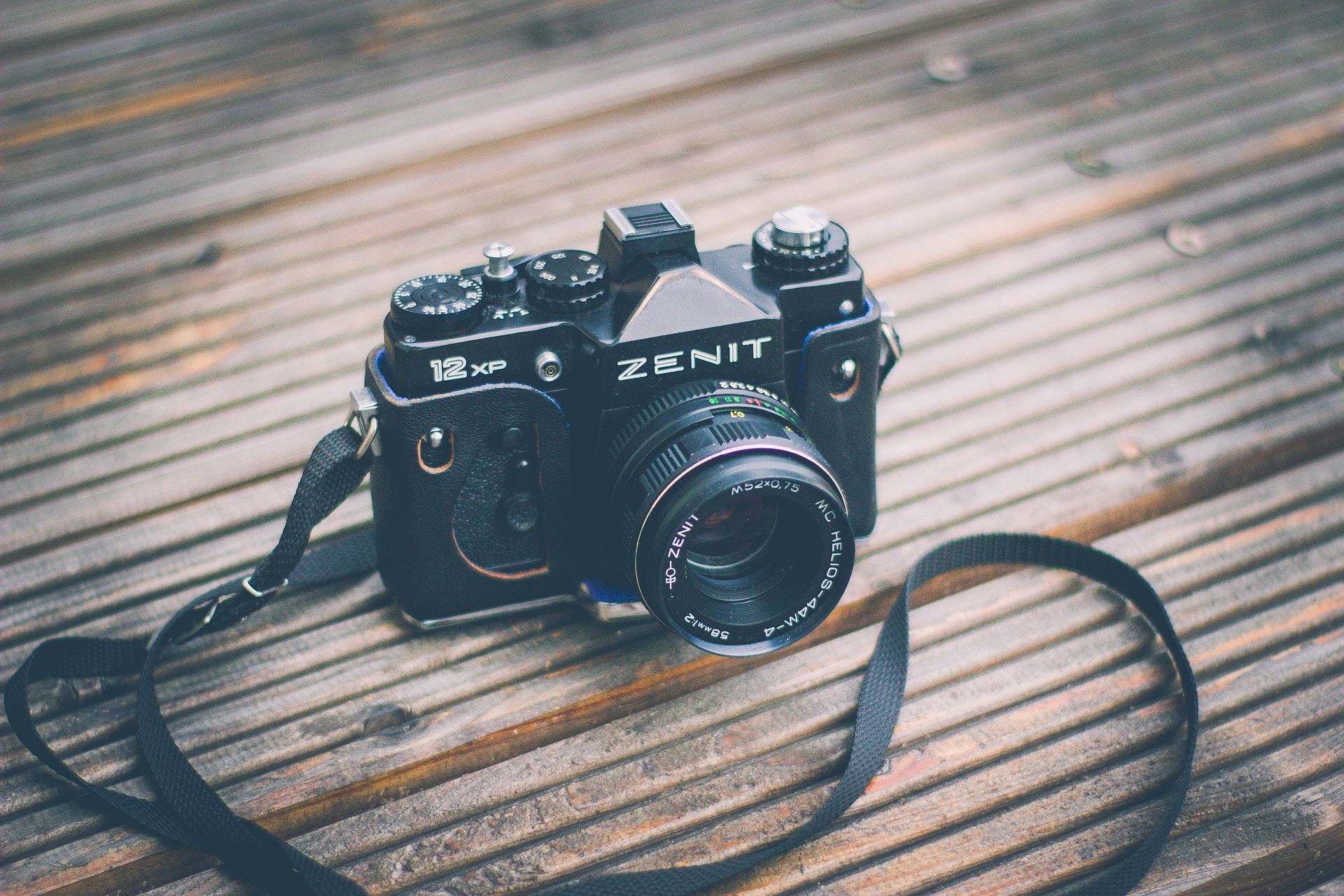
A Zenit-12XP with its characteristic all-mechanical controls. Photograph by Adam Sondel via Pexels, used in Lomography’s Zenit-12XP article.
Zenit-12XP at a glance
- Type
- 35 mm SLR
- Production
- 1983 to 1994
- Lens mount
- M42 screw mount
- Typical lens
- Helios 58 mm f/2
- Meter
- Dual LED XP indicator
- Weight
- Approx. 0.95 kg
- Shutter
- 1/30 to 1/500 s, plus Bulb
- Film speed
- ISO 16 to 500
The Zenit-12XP I own came into the family from Moscow in the 1980s and eventually ended up with me, fitted with a HELIOS-44M-4.
It is the camera that taught me proper SLR photography. Film, mirror, shutter, aperture ring, focus ring and wind lever, with no screen on the back to tell me whether I had made a mess of it. I had to choose the shutter speed, choose the aperture, get the focus right and then wait for the roll to come back before finding out whether any of those decisions had been sensible.
I took some lovely photographs with it, and I still have a soft spot for the very mechanical thunk-and-whirr of a Zenit doing exactly what a Zenit does.
Mine now needs some work, which is what sent me looking for decent repair documentation.
There is quite a lot of Zenit material scattered around the web, but much of the English material I found was incomplete, weakly translated or missing the diagrams that actually matter once the camera is open on the bench. The useful material turned out to be the original Russian documentation preserved by Zenitcamera: the repair manual, user manual and parts catalogue.
At first I was simply looking for enough information to repair my own camera. Once I had started digging through the source pages, though, it became obvious that there was a better job worth doing: preserve the originals properly, rebuild the English versions with the diagrams in the right places, and keep enough of the source trail that somebody else could check the work later.
The restored manuals
The three English manuals were rebuilt from the Russian Zenitcamera sources.
The PDFs are what I would normally use at the bench. The markdown versions are there for anyone who wants searchable text, wants to inspect the translation, or wants to rebuild the documents into another format later.
Recovering the source
I did not want to copy the visible text from the Zenitcamera pages into a document and call that preservation.
The source pages were archived directly, including the raw HTML, inline images and the higher-resolution files linked behind preview images where those existed. That mattered because some of the most useful repair diagrams and catalogue plates were only being shown as reduced previews on the page.
The first extraction also demonstrated why keeping the original pages was worthwhile. Old character-encoding behaviour mangled parts of the Cyrillic text, so some material that looked fine in the browser came out damaged or incomplete when extracted.
I went back to the archived HTML, repaired the Cyrillic extraction, rebuilt the Russian markdown and then checked the figures against the source pages.
The figure placement was worth doing carefully. In a repair manual, a diagram is part of the instruction. An adjustment drawing, shutter mechanism or exploded assembly sitting several sections away from the text that refers to it is not merely untidy; it makes the manual harder to use.
That process produced the English manuals, but it also produced the things needed to check them later: the original pages, image-placement map, source manifest, glossary and translation notes.
Archive
Everything used to build the manuals is available here rather than hidden behind the final PDFs.
English manuals
Source markdown
Mappings and references
Original Russian sources
The translation is intended to stay close to the original organisation, procedures and technical meaning rather than becoming a newly written replacement manual. Where a Russian term needed interpretation rather than a literal substitution, the glossary and translation notes record what I used and why.
If something in the English version looks questionable, the archive gives you a route back to the source rather than an unexplained PDF that has been copied around the internet for twenty years.
Original sources
The source material came from the Zenitcamera documentation for the Zenit-12XP / Zenit-12SD:
I started all of this because I need to repair my own Zenit-12XP. By the time I had recovered the pages, fixed the Cyrillic extraction, mapped the figures and rebuilt the manuals, keeping the result to myself would have been rather pointless.
These cameras are still being used and repaired decades after they were made. The information is still useful, so it may as well be easy to find.