ASSESSMENT SUPPORT PAGE

Rover Prototype: Space Robot Inspiration

Your VEX IQ Gen 2 rover does not need to copy one famous rover. Real space robots are designed for different worlds, different surfaces and different jobs. Some roll. Some land. Some fly past. Some collect samples without ever touching the ground.

Use these examples as engineering inspiration. Look for ideas about movement, object interaction, stability, protection, testing and how engineers respond when something does not go perfectly.

How to use this page

For your Starter Pack research page, do not just write “I found this rover.” Choose a feature, explain what it does, then explain how it could help your own VEX rover meet the project requirements.

Useful sentence starter: “This feature could help our rover because...”
NASA Perseverance rover selfie on Mars
MARS ROVER

Perseverance: the travelling science lab

Perseverance is a rover that landed in Jezero Crater on Mars. It searches for signs of ancient microbial life and collects samples of Martian rock and regolith for possible future return to Earth.

The story is useful because Perseverance is not just a moving platform. It is a carefully arranged system of wheels, cameras, instruments, sample storage and protected components. Everything has a job.

Engineering problem and response: Perseverance’s first drilling attempt produced an empty sample tube because the rock broke apart during drilling. The team investigated the result, chose a stronger target rock, added careful inspection steps, and then successfully collected a core sample.
Design idea to borrow: Put tools where they can actually reach the object. If your rover needs to collect, lift, carry and transport something, the object mechanism needs a clear path to the target.

Source: NASA Perseverance mission page
https://science.nasa.gov/mission/mars-2020-perseverance/

Front view of the LEV-2 SORA-Q lunar rover
TINY LUNAR ROVER

LEV-2 / SORA-Q: the small rover with a clever body

LEV-2, also called SORA-Q, travelled with Japan’s SLIM Moon lander. It was a very small rover designed to separate before landing and move on the lunar surface. Its story is useful because it shows that a rover does not have to look like a car to solve an engineering problem.

The SLIM mission also shows how engineering systems can still produce useful results when the overall landing situation becomes difficult. JAXA reported that SLIM landed successfully but at an unexpected attitude, limiting solar power. The spacecraft was shut down to protect its battery, while LEV-1 and LEV-2 had already separated successfully.

Engineering problem and response: SLIM’s attitude after landing meant solar power was not available as planned. JAXA shut it down to avoid over-draining the battery and prepared for recovery when sunlight conditions improved.
Design idea to borrow: Think beyond “normal wheels.” A compact, unusual body shape can still be a serious engineering solution if it helps the robot move, fit, balance or survive.

Source: JAXA SLIM landing outcome
https://global.jaxa.jp/press/2024/01/20240125-1_e.html

Illustration of the Philae comet lander
COMET LANDER

Rosetta / Philae: landing where gravity barely helps

Philae was carried by ESA’s Rosetta spacecraft and sent down to land on comet 67P/Churyumov–Gerasimenko. This was not like landing on Earth. A comet has extremely weak gravity, so a lander can bounce away if it does not hold on properly.

Philae touched the comet, but the anchoring harpoons did not fire and the lander bounced before settling in a less useful position. Even so, it still returned valuable science data from the comet surface.

Engineering problem and response: The anchoring system did not work as planned, so the mission team used the data Philae did return, kept trying to communicate with it, and Rosetta later imaged the lander’s final position. Finding Philae helped scientists understand the data in the correct surface context.
Design idea to borrow: If your rover needs to grab, lift or carry an object, the contact point matters. A claw, hook or scoop that does not engage reliably can make the whole task fail.

Source: ESA Rosetta mission page
https://www.esa.int/Science_Exploration/Space_Science/Rosetta

Illustration of NASA Stardust spacecraft
COMET SAMPLE RETURN

Stardust: catching comet dust without smashing it

Stardust flew past Comet Wild 2 and collected dust from the comet’s coma. It then returned a sample capsule to Earth. NASA describes it as the first spacecraft to bring samples from a comet to Earth.

The clever part is the collector. Stardust used aerogel, a very low-density material, to “soft-catch” tiny high-speed particles. The design problem was not just “collect the object.” It was “collect the object without destroying the object.”

Engineering problem and response: Comet particles were moving extremely fast and could have been destroyed by a hard collector. Stardust solved this by using aerogel, which slowed and trapped particles more gently before the sample capsule returned to Earth.
Design idea to borrow: Object interaction is not always about force. Sometimes the best collector is shaped, padded, angled or slowed so the target object stays controlled.

Source: NASA Stardust mission page
https://science.nasa.gov/mission/stardust/

Illustration of the Venera 13 probe
VENUS LANDER

Venera 13: engineering for a brutal world

Venera 13 landed on Venus in 1982. Venus is not gentle: it has crushing pressure and extreme heat. Venera 13 still returned images, drilled into the surface and analysed a sample.

This is a useful design story because the lander did not need to survive forever. It needed to survive long enough, protect its instruments long enough, and complete the mission before the environment won.

Engineering problem and response: Venus would destroy ordinary electronics quickly. Venera 13 solved the short mission by using a protected pressure vessel and thermal protection so the instruments could operate long enough to send data back.
Design idea to borrow: Protect the important parts first. On your rover, the VEX brain, battery, motors, sensors and cables need to be secured so the robot can survive repeated testing.

Source: NASA NSSDC Venera 13 record
https://nssdc.gsfc.nasa.gov/nmc/spacecraft/display.action?id=1981-106D

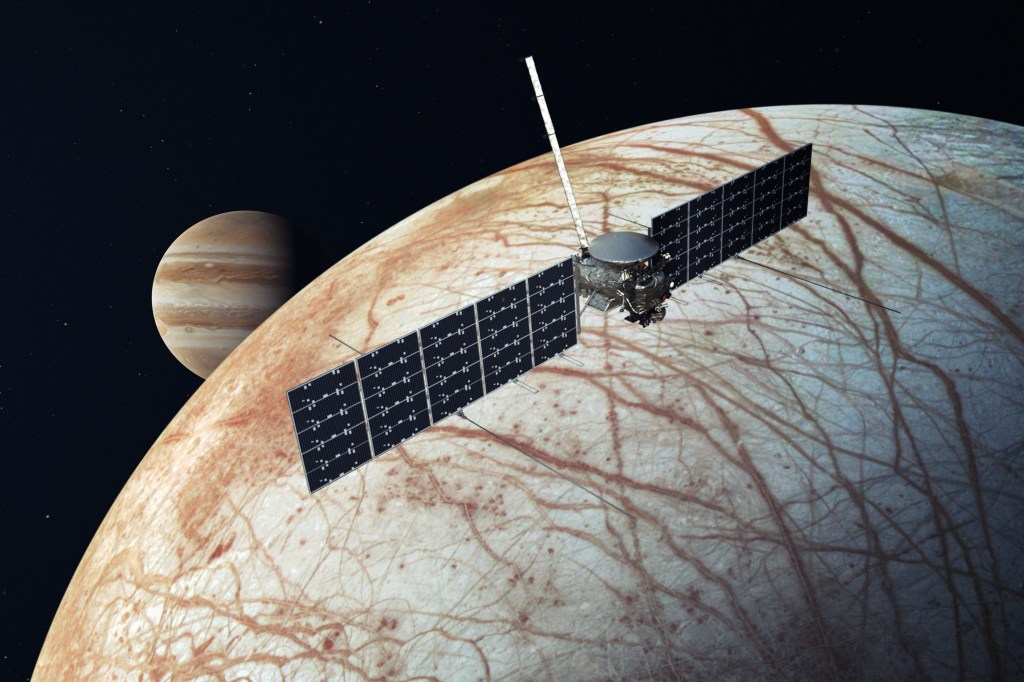
Artist concept of NASA Europa Clipper spacecraft near Europa
CURRENT DEEP SPACE MISSION

Europa Clipper: exploring without landing

Europa Clipper launched in October 2024 and is travelling to Jupiter’s moon Europa. It will not land. Instead, it will orbit Jupiter and make repeated close flybys of Europa to study whether that icy moon has conditions suitable for life.

This is useful because it reminds us that not every explorer solves the problem by touching the surface. Sometimes the safest design is to keep the main system protected and collect information from repeated passes.

Engineering problem and response: Jupiter’s radiation environment is harsh. Europa Clipper responds by using a protected spacecraft design and by making flybys instead of staying close to Europa all the time.
Design idea to borrow: You do not always need to expose every part of your robot. Sensors, wires and fragile parts can be placed behind structure while the working mechanism reaches out.

Source: NASA Europa Clipper mission page
https://science.nasa.gov/mission/europa-clipper/

Turn inspiration into a design decision

Pick one feature from one explorer above. Then use the pattern below in your Starter Pack research page.

Explorer: ________________________________

Feature observed: ________________________________

What the feature does: ________________________________

How this could help our VEX rover: ________________________________

What to remember

Good engineering is not just copying a famous machine. Good engineering means choosing a feature because it helps solve your problem. If your rover needs to collect, push, lift, carry and transport objects, every design choice should help that job become more reliable.